
Read more about:

This year’s Conversations and Connections explored the important topic of social isolation with the help of an expert panel—(left to right): CPH Dean Melissa Perry, George Mason student Jawad H., LaToya Thomas (principal and founder, Brick & Story), Mary Louise Pomeroy (PhD Health Services Research ’22 and postdoctoral fellow at Johns Hopkins), and George Mason’s Chief Mental Health Officer Rachel Wernicke. The panel agreed that loneliness is an epidemic that our nation can address comprehensively.
Is Loneliness a Public Health Crisis?
When George Mason student Jawad H. heard talk of reducing hours at the 24/7 campus dining hall, he saw more than a logistical issue—he saw a threat to a special space where students could still connect in person. “I ran into a friend there at 11 p.m.,” he said. “By the time we finished talking, it was 3 a.m.”
As a Student Government member, Jawad helped mobilize peers to preserve the dining hall’s hours—and its role as a social lifeline.
The importance of intentional connection was central to “Stronger Together: The Impact of Social Ties on Public Health,” a panel hosted by the college. This year’s National Public Health Week event explored how loneliness is increasingly seen as a public health threat.

Photo by Evan Cantwell
“Perhaps nothing has changed more profoundly in recent years than how we interact,” said Dean Melissa Perry, who moderated the panel. “We may check our phones hundreds of times a day but go days without a real conversation. That disconnect has real health consequences.”
Two events helped elevate the issue: the isolation of the COVID-19 pandemic and a 2023 advisory from then-U.S. Surgeon General Vivek Murthy declaring loneliness “a national epidemic.” His report links social isolation to increased risks of heart disease, stroke, and dementia. Loneliness, he warned, is as deadly as smoking 15 cigarettes a day.
“I’m glad there’s a spotlight,” said Rachel Wernicke, George Mason’s chief mental health officer. “Loneliness has been [seen as] an individual’s problem, as opposed to a structural one. We’re seeing more acceptance that there’s a collective responsibility for addressing this.”
Panelists focused on two vulnerable groups: older adults and young people.
Mary Louise Pomeroy, PhD Health Services Research ’22 and postdoctoral researcher at Johns Hopkins, noted that 1 in 3 older adults report frequent loneliness. For them, technology—like video chats or “social robots”—can ease isolation.
For young people, though, technology can worsen it. “Their mood is just dropping,” said Wernicke, describing the effects of passively scrolling social media.
LaToya Thomas, founder of Brick & Story, emphasized the need for deliberate connection. She cited tailgates as examples of people transforming empty spaces into vibrant communities. “It’s the intentionality of what we as social animals decide to do,” she said.
“I’m glad there’s a spotlight [on social isolation]. Loneliness has been [seen as] an individual’s problem, as opposed to a structural one. We’re seeing more acceptance that there’s a collective responsibility for addressing this.”
Rachel Wernicke,
George Mason’s chief mental health officer
Ways the College Is Encouraging Social Connections
- Student Convenience Center:
Created area for students to buy, refrigerate, heat food, and socialize. - Social Connection Mondays:
Encouraging faculty and staff to be on campus every Monday to connect with colleagues - Research
SW Assistant Professor Melissa Villodas studies how social factors affect youth mental health
PhD Student Research Brief: COVID-19 and Student Mental Health
Mental health needs spiked among college students during the pandemic, but they used fewer supports, according to a study published in Psychological Reports, by PhD in Public Health student Elaine Russell and her mentor, GCH Professor Kenneth Griffin. “More U.S. college students suffered from mental health concerns during the pandemic, but fewer received necessary mental health treatment,” said Russell. Additionally, researchers found that students of color, especially females, were less likely to receive mental health services.
This is the first study to use a national dataset to examine changes in student mental health and service use from pre- to peak-COVID. Russell’s research calls for investment in culturally competent mental health care and solutions that break stigma, improve access, and reach the students who need help the most.
Students Lead, Learn, and Forge the Path for Public Health’s Future
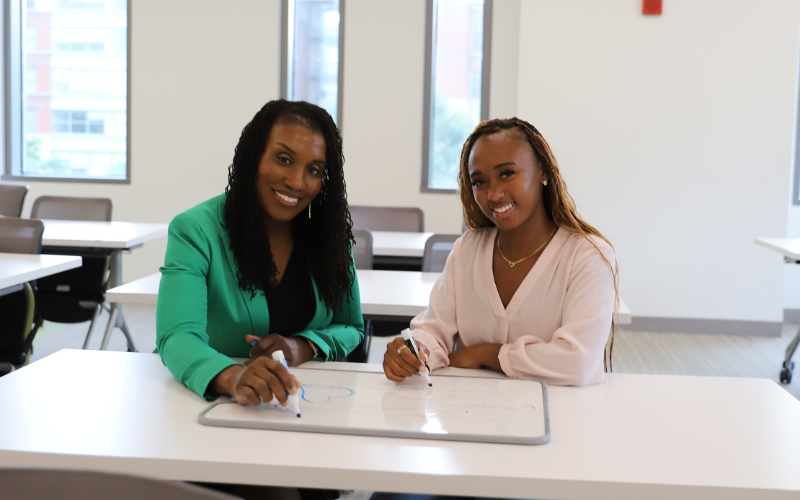
Paris Stephens, BS Community Health ’25, (right) helped develop culturally tailored cancer education with her mentor, GCH Associate Professor Michelle S. Williams (left). Guided by dedicated faculty, students engage early in research, allowing them to explore their interests, develop analytical skills, and grow as future health leaders.
Powerful Undergraduate Research
Paris Stephens, BS Community Health ’25
Stephens, under the mentorship of GCH Associate Professor Michelle S. Williams, developed cancer education specifically designed for young African American women. Stephens conducted comprehensive literature reviews, data collection and analysis, and participated in community education campaigns. Her contributions demonstrate how undergraduates can challenge norms and drive meaningful progress in health equity. “I felt compelled to be part of research that educates, advocates, and drives change,” Stephens said. “The focus on breast cancer awareness and disparities deeply resonated with my passion for advancing health equity. I wanted my efforts to matter.”
Experiential learning starts on day one at the College of Public Health. From undergraduate to doctoral levels, students dive headfirst into research, practicums, and student-led initiatives that challenge norms and drive real-world impact. Students are doing more than simply fulfilling academic requirements and shaping their own futures—they’re paving the way for the next generation of public health leaders. Whether advancing equity, building careers, or transforming communities, students lead with purpose and push the field forward.

Practicum Into Purpose
Avani Hariprashad, Master of Public Health ’25
Avani Hariprashad wanted her practicum to be a launching pad to her public health career. At the Alexandria Health Department, she developed a health literacy training curriculum to help community-based organizations weave health literacy into their everyday conversations with community members. She led outreach, shaped strategy, and designed a space founded on mutual respect. By centering community voices and building partnerships, Hariprashad turned her practicum into a sustainable platform for facilitating health education.

Empathy In Health Care
Taveion Mickens, Master of Health Administration ’26
For Mickens, health care leadership is a mission and calling. A U.S. Marine and MHA student, he brings discipline, purpose, and heart to the field. As a recipient of the ERPi Scholarship for veterans, Mickens is committed to building health systems that are both strategic and compassionate. Inspired to address disparities and improve care in underserved communities, Mickens seeks to improve access to care. “Empathy must guide every decision. When administrators lead with compassion, they uplift both their teams and the patients they serve,” said Mickens.

Empowerment Through Action
Tara Altay, PhD Nursing ’27
When rising conference costs threatened access to research, nursing students engineered the solution. Altay and the Graduate Nursing Organization launched a free, interdisciplinary conference at George Mason open to nursing students across the D.C. region. The event brought together students, practitioners, and partners to share knowledge, build community, and amplify voices.
College of Public Health students find problems and solutions every day, and this effort was no exception. “The main motivation was to create an inclusive conference for all nursing degree programs,” Altay said, “where meaningful conversations and peer connections thrived.”
Interprofessional Students and Faculty Champion Sustained Funding for Older Adults
Public health scholars at George Mason are fierce advocates for aging adults. Students and faculty are driving policy change through evidence and expertise. Health Services Research PhD student Linda Hayes Bennett and SW Assistant Professor Li-Mei Chen took their expertise to Capitol Hill to advocate for sustained federal investment in services for aging populations like Medicare, Meals on Wheels, and NIH research—programs that millions of older adults rely on every day.
Photo provided
They met with congressional staff from the offices of Senators Mark Warner and Tim Kaine, and Representatives Don Beyer and H. Morgan Griffith. As part of the Gerontological Society of America’s Advocacy Day, they joined fellow Virginia and Washington, D.C., area academics.
“Our research can play a pivotal role in Capitol Hill conversations,” said Hayes Bennett. “George Mason College of Public Health researchers can yield much needed solutions—and now is the time to start providing them.”

Photo by Rene Ayala
Hayes Bennett brought the voice of Virginia’s communities into the room, sharing how NIH-funded research about the physical and mental health of older adults is already improving lives. Chen spotlighted her innovative work using virtual reality to train nursing home staff in dementia care (see page 17). Their message was bold and backed by data: every dollar invested in NIH research returns two dollars and fifty cents in economic impact.
“As scientists, we adapt to new ways of thinking about health and aging when funding and priorities change. I think the touching stories of how our current work serves and helps older adults in our community and state moved the legislative staff and Congress people we met with,” said Hayes Bennett.
Advocacy is a core function of public health because real change happens when research meets action. In every department, students are trained to influence policy, engage communities, work interprofessionally, and lead with purpose.

Photo by Toshe_O from Getty Images Pro
Just 20 miles from the nation’s capital, George Mason students and faculty leverage their proximity to Washington, D.C., to amplify their voices and research. This year, Health Services Research PhD student Linda Hayes Bennett and SW Assistant Professor Li-Mei Chen brought their expertise to Capitol Hill, advocating for continued federal support for aging services like Medicare and Meals on Wheels.
Reshaping the Landscape of Social Work Education
Nallely Calles Ortega, BSW ’25, and Betzy Balladares Oviedo, MSW ’26, are working to redefine what education in social work can—and should— look like. They launched a George Mason chapter of the national Payment 4 Placement movement to advocate for policy that supports paid internships in social work. Balancing fieldwork with activism, they’re speaking out in support of more substantial national funding to overcome the financial barriers social work students face in accessing experiential learning opportunities. “It’s meaningful to advocate for our peers while contributing to a growing national conversation on equity,” Calles Ortega said.
Social Work Alum and Her Furry Coworker Fight for Kids

Photo by Evan Cantwell
When Samantha Carrico, MSW ’15, enters a room, eyes usually lock onto her charismatic coworker Rylynn, a five year- old Labrador golden retriever mix. While Fairfax County’s facility dog gets all the attention, Carrico is the key to making it all happen.
The supervisor of Volunteer and Partner Services within the county’s Department of Family Services (DFS), Carrico guides children through some of the most difficult moments of their lives, helping them share what they’ve experienced in a safe, trauma informed environment. And Rylynn is there every step of the way.
“I like to call Volunteer and Partner Services the best-kept secret in DFS,” she said. “We’re providing so many resources to families and communities.”
Those resources include their popular holiday assistance program, Adopta- Family; the Befriend-a-Child mentoring program; and body safety classes for children offered in the public schools. Last year, the Body Safety Program alone served 15,000 children.
“It’s been really nice to see the impact that we’re making,” Carrico said. “Prevention is definitely where we’re going to move the needle for child welfare.”
Carrico was instrumental in launching Fairfax County’s facility dog program, the only one of its kind at a family Social Work Alum and Her Furry Coworker Fight for Kids services or social services agency in the country. She and Rylynn trained together through the nonprofit Canine Companions before Rylynn was officially placed with the county in 2021. Rylynn is certified to accompany children to the witness stand when they must testify in court.
“She doesn’t have a vest, a badge, or a gun. She’s not intimidating, and it’s very rewarding for a family or for a child to know that Rylynn is here for them, with no other agenda,” said Carrico.
It all comes back to Carrico’s desire to make a difference, whether she’s offering in-person training or sitting quietly while Rylynn comforts a child in distress. “My heart really lies in wanting to do more.”

Alum Celebrated for Unwavering Impact
Carolyn A. Taylor, BSN ’78, MSN ‘86, was honored as the College of Public Health 2024 Distinguished Alumni. Emeritus member of the college’s advisory board, Taylor’s decades-long service to the university as a clinician, mentor, and faculty member has shaped the lives of many students in the college.
When Public Health Calls, College Graduate Answers

Felicia Baez-Smith, MPH ’19, hit the ground running, starting her job at the Virginia Department of Health the same week she graduated. Since then, she’s been on a mission to advance public health. As an opioid outreach coordinator, she led overdose response trainings for incarcerated women, equipping participants with lifesaving skills and knowledge. She played a critical role in Virginia’s COVID-19 response and later spearheaded youth mental health first aid initiatives. Now, she coordinates workforce collaboration across 33 health districts. Baez-Smith has dedicated her career to fulfilling a greater purpose and embodies the hustle, ambition, and vision that define exceptional public health leaders. Learn more.
From Tokyo to Tirana:
Learning Global Health Through Lived Experience and Local Insight
College of Public Health students are stepping into the world—literally—to examine complex health systems, cultural dynamics, and policy innovations head-on. Through first-hand experiences in Japan and Albania, they are gaining the skills and perspectives to lead in a global arena.
In Japan, gerontologist and Professor Megmui Inoue guided students how a super-aged society is rewriting the rules of care. They toured elder care facilities, met with health leaders, and studied how Japan blends innovation and tradition to support its aging population. “This trip enhanced my education and observational skills surrounding the cultural differences between the U.S. and Japan,” said Samiah Clarke, BSW ’25.
By engaging with local health care practitioners and NGOs, students deepened their understanding of Albania’s public health and medical systems. Traveling from Tirana’s urban centers to rural communities, they witnessed how public health adapts in real time under real constraints. The students learned about cutting-edge research from global experts at the International Conference of Occupational and Environmental Health Advances. In 2025, the college cohosted the third annual conference.
“This trip provided real-life experience on a global scale, furthering my understanding and passion for public health,” said Susan Favor, BS Community Health ’24, MPH ’25.
These learning moments are high-impact, high-context experiences that challenge students to think critically, act with empathy, and lead with cultural humility.
By embedding students in international environments, the college is building leaders who are globally fluent, locally grounded, and ready to drive change across borders.
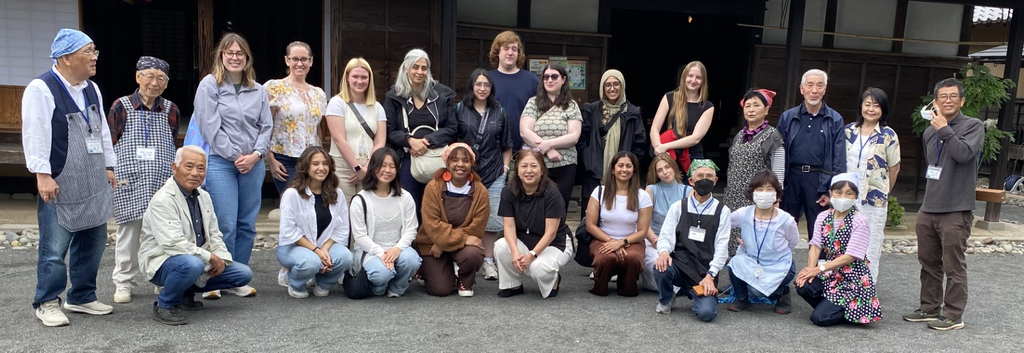
During Rise of the Super-Aged Society, the college’s Japan study abroad program, students visited Ashigawa, one of Japan’s marginalized villages. 50% or more of the village residents are aged 65 or older and the community faces depopulation, isolation, and a lack of public services. More than 10 college faculty members study aging including topics such as nutrition, ageism and health care, caregiver challenges and skills, and social isolation, including SW Professor Megumi Inoue, who led the study abroad trip to Japan.

Study abroad experiences empower future public health leaders to understand health challenges through a global lens by building cultural competence, fostering international collaboration, and driving solutions that make a worldwide impact. During the college’s study abroad program to Albania, led by Dean Melissa Perry, students visited an Institute of Public Health lab to learn how researchers identify vector-born diseases in mosquitoes.
“This trip provided real-life experience on a global scale, furthering my understanding and passion for public health.”
Susan Favor, BS Community Health ’24, MPH ’25
MHA Students Get a Real- World Jolt of Leadership During Trauma Center Visit

Photo by Brenda Helen Sheingold
George Mason University’s Master of Health Administration in Health Systems Management (MHA) students recently stepped out of the classroom and into the activity of Inova Fairfax Hospital’s trauma center—where leadership isn’t theoretical, it can be life-or-death.
This wasn’t just a tour. It was a sneak preview in high-stakes decision making, where every second counts and administrators play a key role in keeping the system running. For students like Vinay Bhakthan, MHA bachelor to accelerated masters student, the experience was a wake-up call. “From coordinating nurse staffing levels and ensuring patient bed availability, to triaging critical cases to trauma rooms and overseeing room turnover after discharges—all while making sure the emergency department is following all regulations and organization policies is an immense task. Seeing these things in person gave me a clear perspective about the realities of the job,” he said.
Pratyusha Satpathy, MHA student, a former physician, saw the invisible architecture of care come to life. “This visit brought many classroom concepts to life,” she said. “It reminded me how essential leadership is in shaping an environment where clinicians can focus on patients while everything else runs smoothly in the background. Everything was thoughtfully planned out, from how easily accessible supplies were, to how rooms could transition into emergency pods instantly. It really showed how administrators are not only managing systems but enabling life-saving care through intentional design and coordination.”
For Marine veteran Taveion Mickens, MHA student, the visit made an impression. “Seeing administrators lead with both precision and empathy reinforced how indispensable they are in creating an environment where health care professionals can thrive and patients can receive timely, quality care.”
The visit also spotlighted George Mason’s powerful alliance with Inova Health System. Through this partnership, students gain rare access to the inner workings of elite health care operations where systems thinking, workforce strategy, and emergency readiness converge.
For Bhakthan, Satpathy, and Mickens, the visit reinforced and redefined their career goals. In George Mason’s MHA program, leadership isn’t a concept. It’s a calling. And in the trauma bay, that calling echoes loudest.
Interprofessional Health Care in Action on ‘The Pitt’
Anyone who’s watched the hit show The Pitt on HBO Max has witnessed the magic of an interprofessional health care team in action. The Pitt is not only wildly entertaining and at times heartbreaking, it brings to life this college’s unique approach to interprofessional education, research, and practice.
From the charge nurse who keeps the Emergency Department afloat to the hospital social worker who counsels grieving families, the show captures the many disciplines required to successfully run a bustling health care operation. Working across functional areas is critical for graduates entering the health care environment—something students in the college experience through hands-on experience and virtual reality simulations.
Lauded as one of the most “realistic” medical dramas, The Pitt captures all too real issues that health workers experience – including burnout, violence, and substance misuse—and spotlights the long-term toll of COVID-19 on our health care system. These are some of the very challenges our researchers are working to address. Woven into the show, we also see the critical role electronic health records play in improving patient care, the importance of having senior administrators who respect and support the medical team, and the role of public health nursing in managing infectious diseases. While The Pitt is a fictional drama, the show underscores the interprofessional nature of truly integrated health and medicine—just like the College of Public Health itself.
Donors Fuel the Future of Public Health
At the College of Public Health, our students are driven by a deep desire to improve lives and uplift communities. But just like the people they aim to serve, many face real-life challenges that can stand in the way of their dreams. Scholarships break down those barriers by opening doors for students from all backgrounds to succeed, lead, and make a lasting impact. By investing in scholarships, our donors are empowering the future of public health.
College Emergency Fund Keeps Future on Track

photo provided
For Leah Moore, BS Community Health, the path to graduation nearly stopped when financial strain forced her to unenroll for fall 2024. Far from home and under pressure, she faced a reality no student should: stepping away from school.
The setback was heartbreaking, she said, but it was not the end of her story.
When her advisor Troy Lowery told her about the CPH Student Emergency Fund, her degree was within reach again. “The CPH Student Emergency Fund lifted a huge weight off my shoulders and helped me return to school. It reminded me that I’m supported and that my education matters,” she said.
More than financial relief, the fund gave her a renewed sense of belonging and belief in her future. “It gave me hope when I needed it most — and the chance to keep pursuing my future in public health,” Moore said.
Moore’s story is a reminder that when students face real challenges, meaningful support can make a lasting difference.
“The support I received from the CPH Student Emergency Fund came at a critical time and [helped] me remain enrolled and focused on completing my degree. This assistance not only provided a practical solution to an immediate challenge but also reinforced my sense of connection to the university community and its commitment to student success.“
Nasser Alhashem, MS Nutrition ‘25
CPH Student Emergency Fund recipient
"Growing up in poverty and facing many adversities, I have always been determined to overcome obstacles and create a brighter future for myself. My passion for social work stems from my own life experiences, and I am committed to dedicating my career to helping others who are facing hardships. This scholarship not only helps me financially but also reaffirms my belief in the power of kindness and generosity."

Brittany James, BSW '25
Miriam Raskin Scholarship recipient
“Receiving this scholarship has alleviated a considerable financial and mental burden, allowing me to dedicate additional time to my studies. Your generosity has provided me with the support I needed during my final semesters, and I am truly grateful for this opportunity. This scholarship has reignited my motivation to succeed, and I am committed to paying forward this kindness in the future.”

Viola Zhao, MS Health Informatics ‘25
Susanna Ezeanii and Mayfred Jolinda Nall Health Informatics Scholarship recipient
Make a gift toward scholarship or the department of your choosing!
“Childcare expenses have been one of the most difficult parts of my journey. Having reliable daycare will give me the peace of mind to focus on my classes and clinicals without worrying about my children’s care. This scholarship will reduce some of the financial pressure I feel every semester.”

Olya Lee, BSN ’26, Lettie P. Whitehead Scholarship recipient

This mural, created by Anna Simakova, BFA ’26, represents the college’s vision to create a healthier tomorrow for all, prioritizing prevention today. It is a visual representation of the college’s departments, values, and mission to build healthier futures through interprofessional education, innovative research, and dynamic partnerships.
College Leadership
Melissa Perry
Inaugural Dean
Robert Weiler
Senior Associate Dean for Academic Affairs
Alison Evans Cuellar
Associate Dean for Research
Brian Gillette
Interim Associate Dean for Student Affairs
Catherine Tompkins
Associate Dean for Faculty and Staff Affairs
Anthony Piantieri
Chief Business Officer
Todd Marrs
Senior Director of Development
Lisa Joyner
Executive Director of Finance and Administration
Michelle Thompson
Director of Marketing and Communications
Department Leaders
Terri Rebmann
Divisional Dean, School of Nursing
Martin Binks
Chair, Nutrition and Food Studies
Rima Nakkash
Interim Chair, Global and Community Health
Emily Ihara
Chair, Social Work
Panagiota Kitsantas
Interim Chair, Health Administration and Policy
Impact Report 2024-25
Managing Editor - Michelle Thompson
Editor - Mary Cunningham
Editorial Staff
Danielle Hawkins
Sarah Supsiri
Taylor Thomas
Designer - Karen Brown
Contributors
Shayla Brown
Priyanka Champaneri
Jennifer Pocock
Photographers
Ron Aira
Emma Anderson
Rene Ayala
Kyler Beke
Evan Cantwell
Max Taylor, Max Taylor Photography
Online Version - Heather Carroll
College Advisory Board
Elma Levy, Chair
Dovel Technologies
Co-founder
Patricia Haresign, Vice Chair
Coaching Wellness for Life
Health & Wellness Coach, Founder
Jason Alexander
Optum Serve
Vice President, Medical Disability Examination Program
Anton Arbatov
SOC Telemed
Vice President of Revenue Cycle Management and Compliance
Theresa Davis
AVP Nursing High Reliability Operations Center
Inova Health System
Yoshie Davison
Mental Health Advocacy
Strategic Partnership Leader
David Goldberg
Mon Health System, President and Chief Executive Officer
Vandalia Health, Executive Vice President
Janet Hinchcliff
The MITRE Corporation
Principal, Health Program Strategy, Health Innovation Center
Ondrea McIntyre-Hall
Kaiser Permanente of the Mid-Atlantic States
Senior Director of Community Health
Philip Zane
Faculty Representative, Chair, College Faculty Council
Associate Professor, Health Admnistration and Policy
Board Members Emeritus
Eleanor (Ellie) Dehoney
Kevin Donnellan
Mary Ann Friesen
Carolyn A. Taylor
Les Taylor
College Alumni Board
Vince Pereira, MHA ’14, President
Syreen Goulmamine, MPH ’23, Vice President
Cordelia Cranshaw Skeete, BSW ’14
Kathi Huddleston, BSN, MSN, PhD ’08
Kelly Kogan JD, MS '21, PhD '23
Felicia Baez-Smith, BA '17, MPH '19
Read more:
Our College
Features